Dallas–Fort Worth metroplex
Concrete Staining & Polishing
Acid stain, dye and mechanically polished concrete — turning the slab you already have into a finished floor for patios, interiors and commercial space.
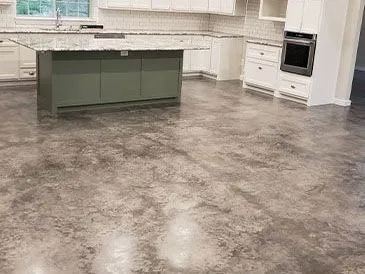
The floor is already there. This finishes it.
Polished concrete is not a coating. It is the slab itself, ground and honed through progressively finer diamond grits and densified with a chemical hardener until the surface takes a sheen from its own density. Nothing sits on top to peel, and it gets harder with wear rather than softer.
It is the right answer for patios and covered outdoor living, for commercial and retail interiors where a coating would not survive the traffic, and for modern homes where the concrete is meant to read as the finished material.
Acid staining
Reactive metallic-salt stains that chemically bond into the slab for mottled, variegated earth tones no two of which repeat.
Dyes
Penetrating dyes for consistent, saturated colour and a much wider palette — including greys, charcoals and blues acid stain cannot reach.
Mechanical polishing
Progressive diamond grinding from 30 to 3000 grit, with a lithium silicate densifier, to matte, satin or high-gloss.
Protection
Penetrating sealers and stain guards for interiors; UV-stable and slip-rated sealers for patios and pool decks.
Scope
What a concrete staining & polishing project includes
Patios & outdoor living
Staining and sealing covered patios, walkways and pool decking with a slip-rated, UV-stable finish.
Commercial interiors
Showrooms, retail, offices and back-of-house slabs polished to a specified gloss level and maintainable with a scrubber.
Residential interiors
Exposed polished concrete in modern homes, basements and workshops — often paired with hardwood in the living spaces.
Repair & resurfacing
Grinding out old adhesive, patching spalls and pouring a cementitious overlay where the existing slab is too damaged to polish.
Questions
Concrete Staining & Polishing questions, answered
What is the difference between polished concrete and a concrete coating?
Polished concrete is the slab refined into a finish — ground and densified so the surface itself becomes hard and reflective. A coating is a separate material bonded on top.
The practical difference is failure mode. A coating can delaminate, peel or scratch through to a different colour underneath. Polished concrete has nothing to delaminate; it can be re-honed decades later and look new again. Coatings win on colour range and on covering a slab that is genuinely ugly.
Acid stain or dye — how do I choose?
Acid stain reacts chemically with the lime in the concrete, so the colour is permanent, UV-stable and beautifully variegated — but the palette is limited to earth tones and the result is genuinely unpredictable, varying with the slab own chemistry.
Dyes penetrate rather than react, giving consistent, repeatable colour across a much broader range including greys and charcoals. Dyes are less UV-stable, so we use them indoors and reserve acid stain for patios and anything in daylight.
Can any slab be polished?
Most can, but not all. A slab needs to be reasonably flat, structurally sound and hard enough to take a polish — very soft or badly spalled concrete will not densify well.
The other variable is what is in the slab. Once grinding starts, whatever aggregate is down there is what you get: a light grind keeps a cream finish, a deeper grind exposes sand, and deeper still exposes stone. We grind a test patch first so you can see the actual floor before committing.
Is polished concrete slippery?
Dry, a polished floor typically has better slip resistance than polished stone or high-gloss tile, because the texture is in the surface rather than in a coating.
Wet is a different question, and it is why we specify differently outdoors: patios and pool decks get a slip-rated sealer or a fine aggregate additive rather than a high-gloss polish.
How much maintenance does a stained or polished floor need?
Interior polished concrete needs dust mopping and occasional damp mopping with a neutral cleaner. No waxing, no stripping, no resealing — that is the main reason commercial clients specify it.
Stained and sealed patios need the sealer refreshed every three to five years depending on sun exposure. It is a straightforward reapplication, not a re-do.
Also from Artistry Floors
Most whole-home projects use more than one material
We install every surface in the house, so transitions line up and one contractor stands behind the whole floor.
Concrete Staining & Polishing across Dallas–Fort Worth
Free, itemised estimates for whole-home and multi-room projects. Call 469.604.5320 or send the details and our team will follow up within one business day.